

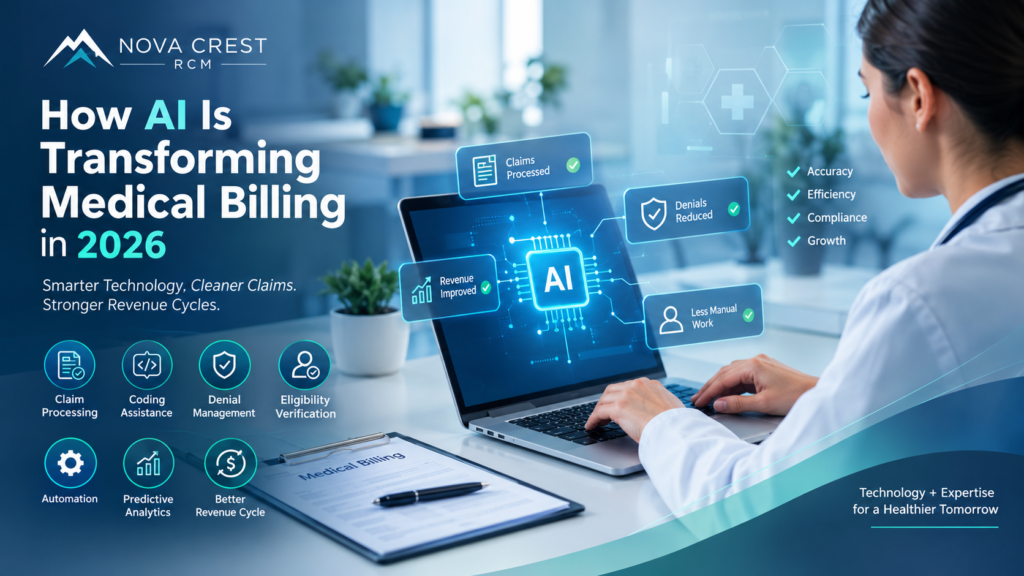
AI in medical billing is transforming the way healthcare organizations manage claims, reduce administrative work, identify billing errors, and improve revenue cycle management. In 2026, artificial intelligence is becoming increasingly integrated into medical billing workflows, helping billing teams process information more efficiently while allowing staff to focus on more complex tasks.
From automated claims analysis to intelligent denial management, AI is changing several stages of the healthcare revenue cycle.
What Is AI in Medical Billing?
AI in medical billing refers to the use of artificial intelligence, machine learning, natural language processing, and automation technologies to support healthcare billing and revenue cycle management.
AI-powered systems can analyze large amounts of healthcare and billing data, identify patterns, detect potential errors, and assist billing teams with tasks such as:
- Claims processing and analysis
- Medical coding assistance
- Eligibility verification
- Claim scrubbing
- Denial prediction and management
- Payment posting
- Accounts receivable analysis
- Revenue cycle reporting
Rather than replacing medical billing professionals, these technologies can help reduce repetitive administrative work and provide billing teams with data-driven insights.
How AI Is Changing Medical Billing
1. Automated Claims Analysis
Claims contain large amounts of information that must be reviewed before submission. AI can analyze claim data and identify potential issues that could result in rejections or denials.
AI-powered claim analysis can help identify:
- Missing information
- Inconsistent patient data
- Coding-related issues
- Payer-specific requirements
- Duplicate claims
- Potential billing errors
Identifying these issues before submission can help healthcare organizations improve the quality of their claims.
2. AI-Powered Claim Scrubbing
Traditional claim scrubbing relies heavily on predefined rules. Modern AI-based systems can analyze historical billing data and recognize patterns associated with claim rejections and denials.
An AI medical billing system can flag potential problems before a claim reaches the payer, giving billing teams an opportunity to review and correct the claim.
This proactive approach can support cleaner claims and more efficient revenue cycle management.
3. Intelligent Denial Management
Denial management is one of the most important areas of medical billing.
Instead of simply identifying a denied claim after the fact, AI can analyze historical denial data to identify recurring patterns.
For example, AI can help billing teams identify whether denials are frequently associated with:
- Incorrect or incomplete information
- Coding problems
- Eligibility issues
- Authorization requirements
- Documentation gaps
- Payer-specific rules
By identifying recurring patterns, healthcare organizations can develop more proactive strategies for reducing preventable denials.
4. Medical Coding Assistance
Accurate coding is essential for healthcare reimbursement. AI and natural language processing can assist with analyzing clinical documentation and identifying potentially relevant codes.
AI-assisted coding does not eliminate the need for qualified coding professionals. Instead, it can help reduce repetitive work and provide additional information for human review.
The final coding decision should remain subject to appropriate professional and organizational review.
5. Eligibility and Insurance Verification
Insurance eligibility verification can consume significant administrative time.
AI and automation can help streamline the process by organizing information and identifying potential eligibility issues before services are provided or claims are submitted.
Earlier identification of insurance-related problems can help reduce billing delays and unexpected claim issues.
6. Accounts Receivable and Payment Analysis
AI can also be used to analyze accounts receivable data.
By examining outstanding balances, payer behavior, claim status, and historical payment patterns, AI systems can help billing teams identify accounts that may require additional attention.
This can support more organized A/R management and help organizations prioritize billing activities.
7. Predictive Analytics for Revenue Cycle Management
One of the most valuable applications of AI in healthcare revenue cycle management is predictive analytics.
AI systems can analyze historical data to identify trends and potential risk areas.
For example, organizations can use analytics to understand:
- Which claims are more likely to be denied
- Which payers generate recurring issues
- Where billing delays occur
- Which processes create administrative bottlenecks
- Where revenue leakage may occur
These insights can help revenue cycle teams make more informed operational decisions.
Benefits of AI Medical Billing
When implemented appropriately, AI and automation can provide several potential benefits to medical practices and healthcare organizations.
Reduced Administrative Work
Automation can handle repetitive tasks and allow billing professionals to spend more time on complex claims, exceptions, and patient-related issues.
Faster Claims Processing
Automating parts of the billing workflow can help teams process information more efficiently.
Improved Claim Accuracy
AI-based checks can identify potential errors before claims are submitted, helping billing teams address issues earlier.
Better Denial Management
Analyzing historical denial patterns can help organizations identify recurring problems and develop strategies to reduce preventable denials.
Data-Driven Decision Making
AI can transform large amounts of billing data into actionable insights for revenue cycle teams.
AI and the Future of Revenue Cycle Management
The future of medical billing will likely involve greater integration between artificial intelligence, automation, healthcare software, and revenue cycle management platforms.
Technologies such as AI, machine learning, natural language processing, robotic process automation, and healthcare data interoperability can work together to create more connected billing workflows.
However, successful AI implementation requires more than simply adopting new technology. Healthcare organizations must also consider data security, privacy, compliance, system integration, data quality, and appropriate human oversight.
Is AI Replacing Medical Billers?
AI is changing the role of medical billing professionals, but automation does not necessarily mean eliminating human involvement.
Medical billing involves complex situations that require judgment, communication, payer knowledge, and problem-solving.
AI can handle or assist with repetitive processes, while experienced billing professionals can focus on exceptions, complex claims, denial resolution, payer communication, and quality control.
The future of medical billing is therefore likely to be more human + AI, rather than purely human or purely automated.
How Medical Practices Can Prepare for AI
Medical practices and billing organizations considering AI should start by identifying processes that are repetitive, time-consuming, and data-driven.
A practical approach includes:
- Identify repetitive billing tasks.
- Analyze current claim and denial data.
- Determine where automation can provide measurable value.
- Select technology that integrates with existing systems.
- Establish appropriate security and compliance controls.
- Maintain human review for important billing decisions.
- Measure performance before and after implementation.
Conclusion
AI is becoming an important part of modern medical billing and healthcare revenue cycle management. From claim analysis and coding assistance to denial management, eligibility verification, and predictive analytics, AI can help organizations create more efficient billing workflows.
The goal of AI medical billing should not simply be automation. The real opportunity is to combine technology, accurate data, and experienced medical billing professionals to create a more efficient and proactive revenue cycle.
As healthcare organizations continue adopting AI in 2026 and beyond, organizations that carefully evaluate their workflows and implement technology responsibly can position themselves for a more data-driven approach to revenue cycle management.
Looking to improve your medical billing and revenue cycle management? Nova Crest RCM provides technology-driven medical billing and RCM solutions designed to help healthcare practices streamline billing operations and manage their revenue cycle more effectively.
AI is reshaping medical billing by making claims processing, denial management, coding assistance, and revenue cycle analysis faster and more data-driven. The real advantage comes from combining AI automation with experienced billing professionals to improve efficiency, accuracy, and overall RCM performance.
Interesting!